Explainer · biotics

Postbiotic vs probiotic: the differences that decide your product.

Alive or inactivated. That one choice sets the format, the process and the label.

A probiotic is a live microorganism; a postbiotic is an inactivated one. That sounds like a small difference and it changes almost everything downstream: which formats are possible, whether the product survives pasteurisation, how it is stored, how potency is measured, and what the label may say. This explainer walks through each point, then gives a simple decision guide.

In short

Probiotics are live microorganisms counted in CFU; they need cool storage, lose potency over shelf life and cannot survive pasteurisation, baking or acidic drinks. Postbiotics are inactivated microorganisms counted in cells per gram or milligrams; they survive heat and low pH, store at room temperature for years and fit any format. Probiotics have the larger evidence base; neither has an authorised EU health claim.

Definitions

The same family, two different ingredients.

Probiotic

Live microorganisms which, when administered in adequate amounts, confer a health benefit on the host (FAO/WHO 2001, confirmed by ISAPP 2014). The potency is the number of live cells, stated as CFU (colony-forming units) per dose, and it must hold until the end of shelf life.

Postbiotic

A preparation of inanimate microorganisms and/or their components that confers a health benefit on the host (ISAPP 2021). The cells are inactivated on purpose, usually by heat, and the potency is stated as inactivated cells per gram or as milligrams of powder.

Prebiotic and synbiotic, for completeness

A prebiotic is a substrate, typically a fibre, that is selectively used by host microorganisms. A synbiotic combines live microorganisms with a substrate. Neither is the subject of this page, but buyers often mix the terms up.

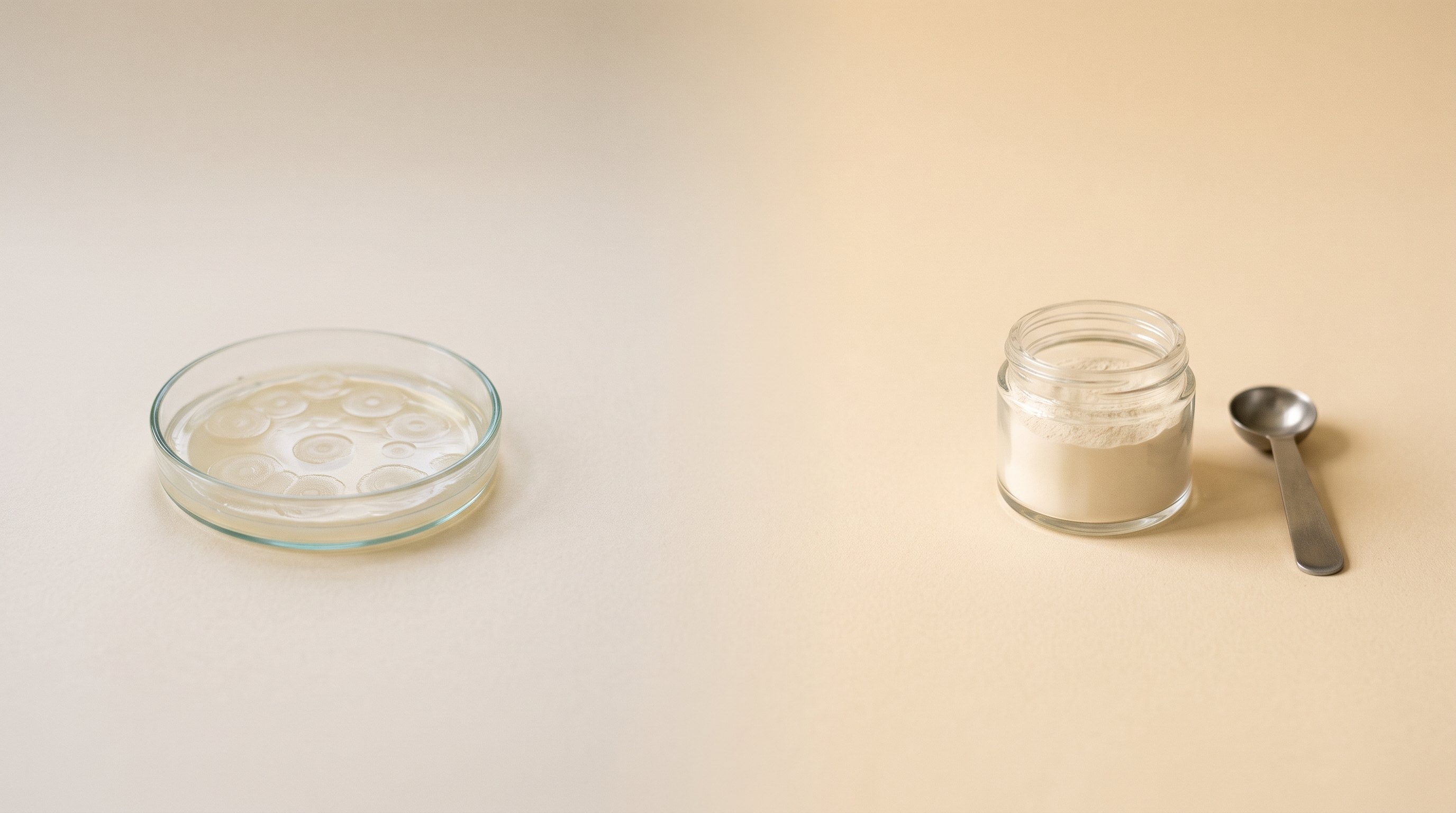
Live probiotic culture in a petri dish next to a jar of dry postbiotic powder
Left: a living culture, counted in CFU. Right: a postbiotic, a stable dry ingredient counted in cells per gram.
Side by side

Nine differences that matter in development.

QuestionProbiotic (live)Postbiotic (inactivated)
How is potency stated?CFU per dose, with an overage to cover lossesCells per gram (flow cytometry) or mg of powder
Does it survive heat?No: pasteurisation, UHT, baking and extrusion kill itYes: already inactivated, no viability to lose
Acidic or moist products?Potency drops in juices, yoghurt drinks, gummiesStable across pH and water activity
StorageOften cool or refrigerated; CFU declines over timeAmbient; typical shelf life 24–36 months
Possible formatsCapsules, sticks, some chilled dairyAny: drinks, dairy, ice cream, bakery, bars, gummies, capsules
ProductionFreeze-dried cultures, handled dry and coolSpray-dried or freeze-dried powder, handled like any dry ingredient
EvidenceDecades of strain-specific human studiesSmaller but growing; must be generated for the inactivated preparation
Safety profileLive cells: a consideration for vulnerable groupsNo live cells: often the argument for infant, clinical and pet use
EU label“Probiotic” tolerated in some member states, not in GermanyNo EU position on “postbiotic”; assume the same treatment
Counting

CFU and cells per gram are not the same number.

A probiotic specification says, for example, 10 billion CFU per capsule at the end of shelf life. To get there, the manufacturer fills more at production, the overage, because live counts fall. The CoA for each batch shows the CFU at release.

A postbiotic cannot be counted in CFU, because the cells do not grow on a plate. Instead, the specification states inactivated cells per gram, measured by flow cytometry, or simply the milligrams of powder per serving. The CoA also shows a maximum residual viable count, which proves that the inactivation step worked.

A practical consequence: “10 billion” on a probiotic and “10 billion” on a postbiotic describe different things and cannot be compared one to one. Read the method on the specification.

Decision guide

Which one for your product?

01

Capsules or stick packs, dry, cool supply chain

Both work. Choose the one with the stronger evidence for your positioning. A combination is common: a live strain plus a postbiotic in the same capsule.

02

Drinks, dairy, ice cream, bakery, bars, gummies

Postbiotic. The process or the matrix would kill a live culture, and a product that loses its active ingredient before the best-before date is not a product.

03

Long ambient shelf life, export to warm markets

Postbiotic, or a spore-forming probiotic. Freeze-dried lactobacilli lose count faster at 30 °C and above.

04

A positioning built on a named, studied live strain

Probiotic. Keep the strain, protect it with the right capsule, packaging and overage, and write the stability plan into the specification.

FAQ

Postbiotic vs probiotic, answered.

Is a postbiotic better than a probiotic?

Neither is better in general. A probiotic has the larger evidence base and needs a format and supply chain that keep it alive. A postbiotic is the only option for heat-treated or acidic products and for long ambient shelf life. The right choice depends on the product.

Can a probiotic turn into a postbiotic?

Only through a controlled inactivation step with evidence generated for the inactivated preparation. A probiotic that simply died in the bottle is not a postbiotic.

Can I combine both in one product?

Yes. Capsules and sticks that pair a live strain with a postbiotic are common. The postbiotic adds nothing to the CFU count, so both are declared separately.

Do postbiotics have side effects?

Inactivated cells do not carry the infection risk that is discussed for live cells in vulnerable groups. Tolerance data come from the studies on each preparation; a supplier should be able to show them.

Which foods contain postbiotics?

Any heat-treated fermented food contains inactivated bacteria, for example baked sourdough or pasteurised sauerkraut, but not in a defined, quantified form. A postbiotic ingredient is a defined preparation with a specification.

May I write “probiotic” or “postbiotic” on an EU label?

The Commission treats “probiotic” as an implied health claim; Italy, Spain, Denmark, the Netherlands, the Czech Republic and Poland tolerate it for live strains under conditions, Germany does not. There is no EU position on “postbiotic”; the safe assumption is the same treatment.

Talk to us

One conversation. One owner.

Send a few lines about your product: format, market, rough volume. Minimum orders: 500 units per SKU for sports nutrition, 60,000 capsules or 300,000 stick sachets for probiotics, bulk probiotic cultures from 50 kg. You get an answer within 24 hours.

Meet us at Fi Europe, Messe Frankfurt, 17–19 November 2026. Book a meeting at the show →

Your contactWladimir ChapiroManaging Director, Nordic Life Systems or email c@nordiclifesystems.com
Chat on WhatsApp
What do you need?

Reply within 24 hours. No newsletter, no follow-up sequence.

Chat with us
Request samples & quote →