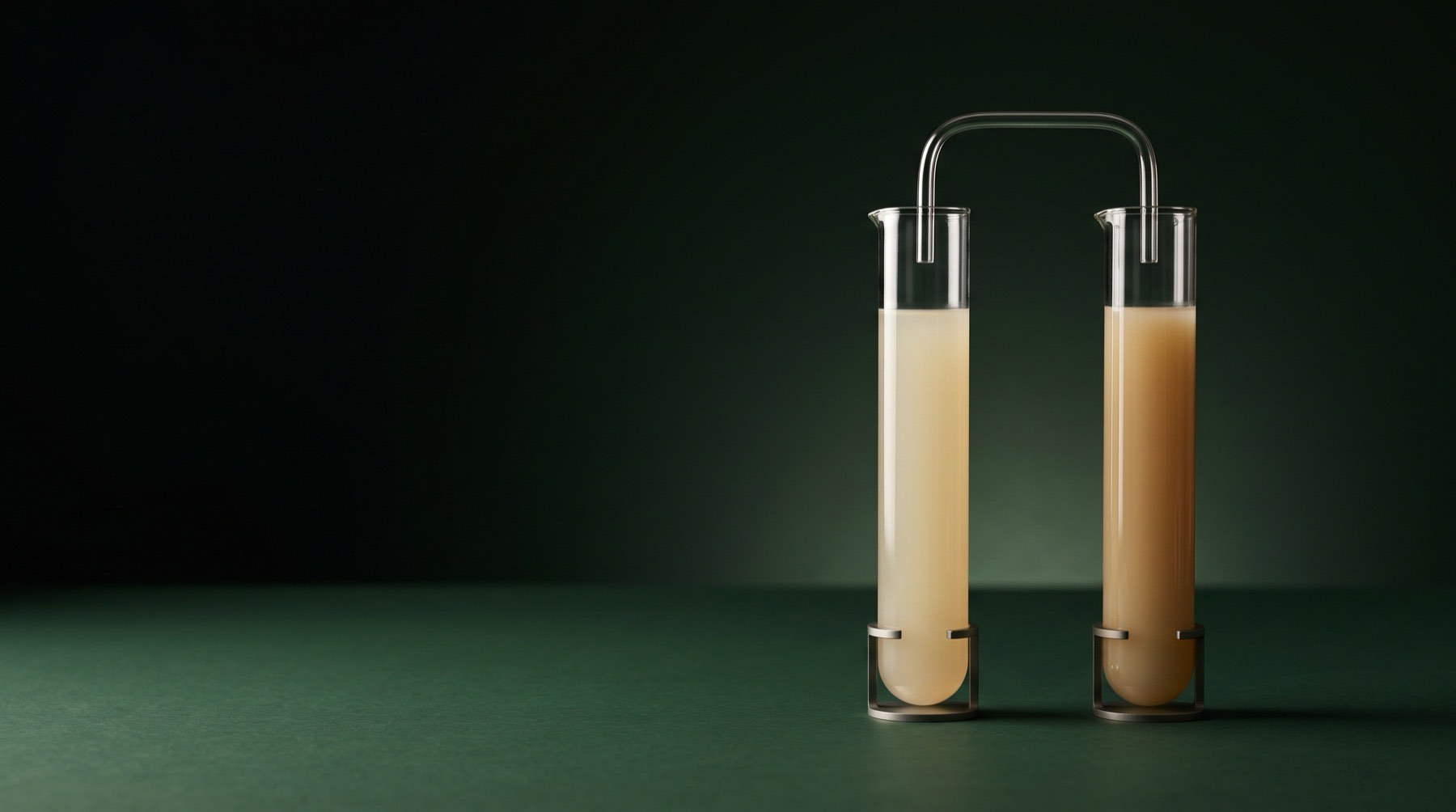
Single strain
One strain is fermented and inactivated. Simple, and limited to what that one strain produces.
A postbiotic is an inactivated, shelf-stable ingredient made from bacteria. MaestroBiome 01 takes the idea further: two strains fermented one after the other in a patented two-step process, then pasteurised and spray-dried. Nothing in it is alive, so it goes where live cultures can’t: drinks, dairy, ice cream, bakery and gummies.
All postbiotics start with bacteria that are fermented and then inactivated. What separates them is how the strains are combined. To our knowledge, this step-by-step (sequential) fermentation is the most advanced way to make a postbiotic at commercial scale.
One strain is fermented and inactivated. Simple, and limited to what that one strain produces.
Several strains are fermented separately and the finished powders mixed. The strains never meet, so the result is simply the sum of the parts.
The second strain grows on the material the first strain has already fermented. It builds on what the first made, which blending and parallel fermentation cannot do. Patented.
MaestroBiome 01 is dosed in milligrams and carries no live cells, so it fits products that live probiotics do not survive in. Every application is confirmed in your recipe and your process during the pilot.
The simplest start. 100 mg fits next to vitamins, minerals or plant extracts in almost any capsule or tablet. No overage, no protective coating and no live-cell count to maintain until the end of shelf life.
Gummy cooking means water and heat. An inactivated ingredient has no live cells to lose; add it to the gummy mass with the other active ingredients.
Functional shots, juices, ready-to-drink (RTD) teas, sports and protein drinks. It disperses in water; add it to the water phase before heat treatment.
Yoghurt, kefir, milk drinks and oat or soy alternatives. Dose into the base before pasteurisation, or into a dry blend.
Freezing cannot harm what is not alive. Add it to the mix before pasteurisation and ageing (resting the mix), like any other dry ingredient.
The powder is already heat-treated and decomposes only above 240 °C. The crumb (the soft inside), which is most of a baked product, stays below about 100 °C. We confirm your recipe in a trial bake.
Mix it dry into the base or add it to the coating. About 3.3 g per kilogram gives 100 mg in a 30 g serving.
Whey, clear whey, plant protein and nutrition blends: add it at the dry-blending step.
We start with a small-scale lab (bench) test in your recipe, run a pilot through your real process, check taste, colour and texture, and set up a stability plan for the finished product. You get the data for your product (your matrix), not a promise.
Filled dots are documented for MaestroBiome 01. Open dots are typical temperatures in your process, which we confirm in a trial with your recipe.
Most postbiotics come from a single strain, fermented and inactivated. Multi-strain postbiotics are usually blends of powders made separately: the strains never meet.
MaestroBiome 01 is built differently. Lacticaseibacillus rhamnosus GG first ferments a food-grade base material (substrate). This fermented, inactivated material then becomes the growth medium (food source) for Lacticaseibacillus paracasei NPB-01. The second strain works on what the first one made, and the result is a composition that parallel fermentation and blending do not reproduce.
The biomass is then pasteurised and spray-dried with a maltodextrin carrier into a light orange powder that disperses in water.
The sequential process is patented and run by our manufacturing partner Science Power S.r.l. in Italy. To our knowledge, MaestroBiome 01 is the only commercial postbiotic produced in a two-stage sequential process.
The fair comparison for a two-strain process is not a placebo. It is each strain on its own, and both strains simply mixed.
In a peer-reviewed laboratory study on human intestinal cells (the Caco-2 cell line), the sequential postbiotic was compared with a postbiotic of each strain alone and with a physical mixture of the two. It reached the highest values on every marker measured.
A second peer-reviewed paper characterises the sugar molecules on the cell surface (polysaccharides) of the NPB-01 strain. These are laboratory results in a cell model, not human data, and they are not health claims. Both publications are available on request.
Key data from the manufacturer’s product information. The current technical data sheet always applies.
| Ingredients | Maltodextrin (maize), yeast extract, inactivated Lacticaseibacillus paracasei NPB-01 and Lacticaseibacillus rhamnosus GG biomass |
| Appearance | Fine, light orange powder; slightly acidic taste with umami notes |
| In water | Water-dispersible; pH of the solution about 6–7 |
| Dose | 50–150 mg per day; 100 mg standard |
| Minimum order | 10 kg |
| Water / sodium | About 5% water; 3.7% sodium (about 3.7 mg per 100 mg dose) |
| Shelf life | 36 months unopened; store cool, dry and away from light. Hygroscopic: keep closed |
| Microbiology | Total bacterial count <100,000 CFU/g; yeasts and moulds <100 CFU/g; coliforms <10 CFU/g; coagulase-positive staphylococci <100 CFU/g |
| Dietary | Vegan, gluten-free, non-GMO; none of the EU major allergens. Not irradiated, not treated with ethylene oxide (ETO) |
| EU status | Outside the scope of the Novel Food Regulation (EU) 2015/2283, based on the manufacturer’s assessment |
| US status | Self-affirmed GRAS (Generally Recognized as Safe) for food and beverages up to 1,000 mg per day (manufacturer’s statement) |
| Documents | Technical data sheet, product information package, Certificate of Analysis with every batch |
100 mg per serving is the usual dose. At that level the impact on taste and colour is small; in clear or delicately flavoured drinks, check the light orange tint and the yeasty notes in a small lab test.
Add it to the water phase or the dry blend before pasteurisation or baking, so it is evenly distributed and goes through the same process as the rest of the recipe.
The powder absorbs moisture (hygroscopic). Keep bags closed and protect dry blends and finished packs from humidity.
The carrier is maize-derived maltodextrin, which matters if you market the product as maize-free. 100 mg adds about 3.7 mg of sodium.
No EU health claim exists for postbiotics. Combine it with a vitamin or mineral that carries an authorised claim under Regulation (EU) 432/2012. EU guide
No. Probiotics are live microorganisms. MaestroBiome 01 is inactivated, which makes it a postbiotic: a preparation of inanimate microorganisms and their components (definition of ISAPP, the International Scientific Association for Probiotics and Prebiotics, 2021). That is also why it is dosed in milligrams, not in colony-forming units (CFU).
It contains no living cells, so there is nothing alive to lose. It is pasteurised during its own manufacture, and the powder decomposes only above 240 °C. Data for a specific process, such as UHT or baking, are generated in a trial with your recipe; we run that with you.
In the EU there is no authorised health claim for any postbiotic or probiotic, and the published research is not a health claim. Brands combine MaestroBiome 01 with a vitamin or mineral that carries an authorised claim, and describe the ingredient factually.
50–150 mg per day, with 100 mg as the standard. One kilogram covers 10,000 servings at 100 mg.
Yes. The peer-reviewed publications, the technical data sheet, the product information package and batch certificates are available on request.
Both. We supply MaestroBiome 01 as a bulk ingredient from 10 kg on standard trade terms, or we develop and manufacture your finished product with it.
For food business operators. B2B technical information, not for consumer communication. No health claims are made for this ingredient.
Tell us your product and process. We send the technical pack and a sample, and help you run the first bench test. Bulk ingredient from 10 kg on standard trade terms, or your finished product made by us.